
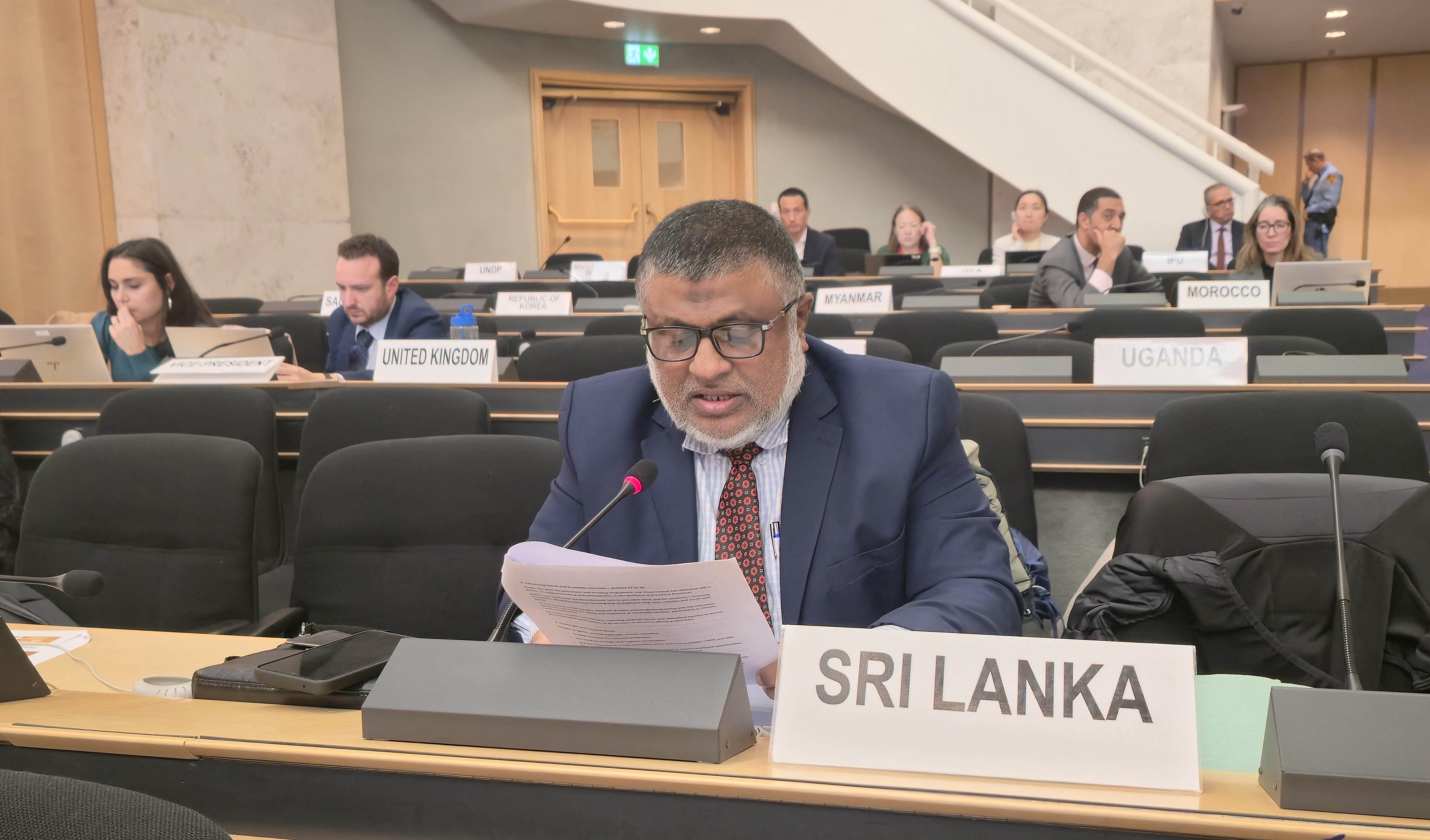
Madam President, Distinguished Delegates, Excellencies, Ladies and Gentlemen,
Sri Lanka is honoured to present an update on our progress in fulfilling the Victim Assistance commitments under Actions 30 to 39 of the Siem Reap–Angkor Action Plan.
- Strengthening National Coordination and Ownership – Action 30
Sri Lanka continues to reinforce national ownership in victim assistance.
The National Mine Action Centre (NMAC) remains the designated national focal point and leads coordination with key ministries, including Health, Rural Development, Social Security and Community Empowerment, and the Department of Social Services.
This inter-ministerial mechanism ensures that mine and explosive ordnance (EO) survivors are supported through a whole-of-government approach.
A revised National Disability Action Plan, aligned with the UN Convention on the Rights of Persons with Disabilities (CRPD), is also underway and includes explicit commitments to mine and EO victims.
2. Legislative Progress
Sri Lanka has taken important steps to strengthen the rights of persons with disabilities. A new Disability Rights Bill, aligned with the CRPD and endorsed by Cabinet in February 2025,is currently being finalized.
This bill will modernize the national framework and ensure a rights-based approach for mine survivors and other persons with disabilities.
3. Inclusive Implementation and Data Management – Actions 31 and 32
The Ministry of Health has integrated landmine victims into the National Injury Surveillance Database, strengthening institutional victim data beyond the mine action sector.
A Victim Assistance Needs Assessment Survey was completed in 2024/2025, covering 20% of recorded victims.
Using modern tools such as Survey123 and the IMSMA Core workflow developed with GICHD,Sri Lanka now has a verified and centralized dataset disaggregated by gender, age, and disability.
A preliminary report has been issued, and the findings will inform our updated national action plan and Article 7 reporting.
4. Access to Services and Referral Mechanisms – Actions 33 to 35
The Ministry of Health and Department of Social Services continue to ensure access to medical care, rehabilitation, psychosocial support, and social protection schemes.
In 2024, National Guidelines for Rehabilitation Services were officially published.
Over 80% of surveyed survivors have received support through national welfare mechanisms such as Aswesuma and disability allowances.
Sri Lanka is now working toward establishing a formal national referral mechanism, including a directory of services accessible to survivors nationwide.
However, livelihood support for survivors—especially those with disabilities—remains an area where additional resources are required.
5. Mental Health and Psychosocial Support – Action 36
Sri Lanka recognizes mental health as a core pillar of survivor well-being.
Medical Officers of Mental Health are now deployed at both preventive and curative levels.Community-based psychosocial support, including peer-to-peer networks, is being expanded in the most affected districts.
6. Advancing Social and Economic Inclusion – Actions 37 to 39
Under the 2026 Resettlement and Housing Programme, the Government has allocated LKR 5
Billion to support housing and reintegration in the Northern and Eastern Provinces.
NMAC has instructed the Resettlement Unit to prioritize mine and EO survivors—ensuring accessible, disability-inclusive housing that strengthens long-term stability and social well-being.
These housing initiatives also integrate disaster-preparedness planning and risk-reduction measures, ensuring the safety and resilience of vulnerable families, particularly in remote rural communities.
Sri Lanka remains committed to removing physical, social, and attitudinal barriers to ensure the meaningful participation of all survivors in decisions affecting their lives.
7. Challenges and Support Needs
Despite progress, several challenges remain, including:
• limited resources for inclusive livelihoods;
• the need for stronger inter-agency coordination;
• and the requirement to fully harmonize victim data across APMBC, CRPD, and SDG
frameworks.
Sri Lanka welcomes continued international cooperation to expand livelihood opportunities,strengthen monitoring systems, and finalize our national victim survey.
8. Way Forward
Sri Lanka is committed to launching an inclusive, data-driven National Action Plan for Victim Assistance integrated fully into national systems.
As a current member of the Committee on Victim Assistance (2025–2026), Sri Lanka will continue promoting survivor-centred approaches, gender equality, and evidence-based planning in line with the Siem Reap–Angkor Action Plan.
We express our sincere appreciation to the Committee, the ISU, GICHD, development partners, and all stakeholders for their continued support.
Together, we can ensure that every survivor receives the care, dignity, and opportunity they deserve.
Thank you.