6 August 2025 — The Government of Sri Lanka has formally deposited its instrument of acceptance of the World Trade Organization (WTO) Agreement on Fisheries Subsidies, becoming one of the latest WTO members to take this important step towards protecting global marine resources. With this ratification, only four more acceptances are needed for the Agreement to enter into force.
This ratification reflects Sri Lanka’s steadfast commitment to sustainable ocean governance and responsible fisheries management, consistent with national policies articulated under the “Thriving Nation and a Beautiful Life” framework. The Agreement prohibits subsidies that contribute to illegal, unreported and unregulated (IUU) fishing and to the exploitation of overfished stocks — both critical concerns for coastal and island nations such as Sri Lanka.
Fisheries remain a cornerstone of Sri Lanka’s food security, export economy, and coastal livelihoods. By aligning national legislation, with global disciplines, Sri Lanka is strengthening its capacity to sustainably manage marine resources while enhancing its credibility in key international markets.
This step also supports Sri Lanka’s broader blue economy agenda and builds on recent international commitments, including signing into the UN Agreement on Biodiversity Beyond National Jurisdiction (BBNJ). The ratification enables Sri Lanka to access technical and financial assistance through the WTO Fisheries Fund, which supports developing countries in implementing sustainable fisheries practices.
The Agreement on Fisheries Subsidies, adopted by consensus at the WTO’s 12th Ministerial Conference in 2022, is the first WTO agreement with an explicit environmental sustainability focus. It is also a significant contribution toward achieving Sustainable Development Goal 14.6, which calls for the elimination of harmful fisheries subsidies.
Sri Lanka’s ratification underscores its leadership in global ocean stewardship and its readiness to engage in cooperative efforts to ensure the sustainability of marine ecosystems for current and future generations.
Permanent Mission of Sri Lanka
to the World Trade Organization in Geneva
07 August 2025
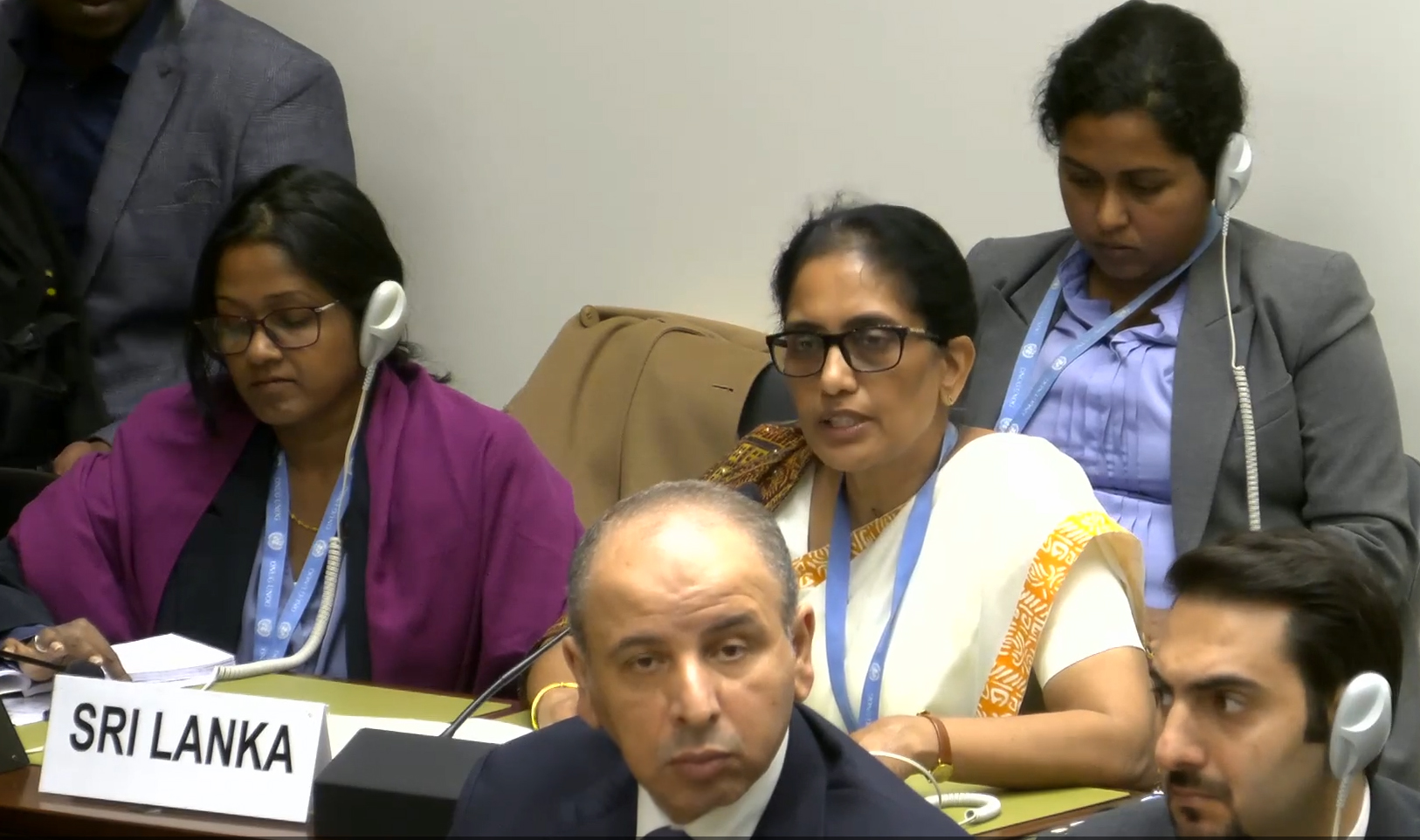
Statement by Sri Lanka
Second session of the open-ended working group on the prevention of an arms race in outer space in all its aspects, 21-25 July 2025, Palais des Nations, Geneva
Item 5 – General Exchange of Views
Mr. Chair
Sri Lanka also joins other delegations in appreciating your leadership as the Chair of this Open-Ended Working Group (OEWG). I extend Sri Lanka´s fullest support and cooperation for the success of the deliberations of the Working Group.
Sri Lanka appreciates your leadership during the first session of the OEWG as well as during the informal consultations and guidance to the second session.
Mr. Chair,
The discussions on prevention of an arms race in outer space are not new to us. We have been discussing the related issues over decades. Therefore, rather than starting from scratch, the OEWG can leverage from where we are, while building on existing discussions and efforts in multilateral fora.
We believe that this working group provides an opportunity for Member States to advance discussions on both legally binding and non-legally binding measures in outer space disarmament under a single framework.
Sri Lanka has been engaging for decades on the matters of prevention of an arms race in outer space, and has been advocating for a legally binding instrument. We also wish to underline the vital importance of verification mechanisms as an integral part of a legally binding instrument. While understanding the current dynamics in space faring activities by States, we believe that this fundamental goal has to be achieved in a balanced and inclusive approach under a comprehensive framework, which recognizes the concerns of all States, and works on the basis of consensus.
The UNGA resolution 79/19 titled ‘prevention of an arms race in outer space’ which is annually presented by Sri Lanka together with Egypt emphasizes “the paramount importance of strict compliance with existing arms limitation and disarmament agreements relevant to outer space, including bilateral agreements, and with the existing legal regime concerning the use of outer space”
The resolution also emphasizes “the necessity of further measures with appropriate and effective provisions for verification to prevent an arms race in outer space” while referring to the important work carried out so far in multilateral fora on outer space disarmament.
From the point where we are today, we all need to strive to agree on a pragmatic way forward to achieve our common goals in outer space disarmament in all aspects.
Sri Lanka also takes this opportunity to underscore that weaponizing of outer space would disproportionately affect all states. We urge this Working Group therefore to adequately listen to the voice of the developing countries that rely on peaceful uses of outer space and space-based assets, particularly satellite technology for communication, disaster management, and climate impact monitoring and resilience. Sri Lanka encourages regional consultations and dialogues particularly among the non-spacefaring states with a view to ensure inclusivity.
Mr. Chair,
It is the responsibility of all States to ensure that outer space remains a shared heritage of humankind, free from conflict and accessible to all nations for peaceful purposes.
While reiterating Sri Lanka’s support to your efforts to bring us on to a pragmatic direction, we believe that a balanced, inclusive and consensus-based approach that considers the concerns of all states will be useful in achieving our common goals.
Thank you

The UN High Commissioner for Human Rights Volker Türk concluded a four-day official visit to Sri Lanka from 23 to 26 June 2025.
During the visit, High Commissioner Türk called on President Anura Kumara Disanayaka and Prime Minister Dr. Harini Amarasuriya and had constructive discussions with Minister of Foreign Affairs, Foreign Employment and Tourism Vijitha Herath, Minister of Justice and National Integration Harshana Nanayakkara, Minister of Public Security and Parliamentary Affairs Ananda Wijepala, Deputy Minister of Foreign Affairs and Foreign Employment Arun Hemachandra and Deputy Minister of Defence Major General Aruna Jayasekara. He also met the Speaker of the Parliament, the Chief Justice and several government representatives.
Discussions focused on measures to advance human rights including economic and social rights, strengthening national reconciliation processes and ensuring social justice. The Government reiterated to the High Commissioner its sincere commitment to achieving these objectives and briefed on the action already taken and those envisaged, including confidence building measures, the Clean Sri Lanka program, anti-corruption initiatives, further strengthening reconciliation mechanisms, repealing the Prevention of Terrorism Act, revising the Online Safety Act and new laws to advance the rights of persons with disabilities.
During deliberations, the High Commissioner highlighted the momentum of change he witnessed across all segments of the Sri Lankan society. He appreciated the Government’s plans on promoting ethical governance, human rights and national unity, and offered the support of his Office to strengthen the Government’s initiatives. High Commissioner Türk said that he was encouraged by the Government’s measures to address corruption and mismanagement and hoped that the momentum would continue. Noting that the discussions had showed genuine openness to address issues, the High Commissioner stated that Sri Lanka can become an example of peaceful co-existence while embracing its diversity as a strength. The High Commissioner stated that he is visiting Sri Lanka with a deep sense of hope at a time when the world and the multilateral system are facing unprecedented challenges.
The High Commissioner also met with several non-government stakeholders including religious leaders, political parties and civil society in Colombo, Jaffna, Trincomalee and Kandy.
In Colombo, he engaged with representatives of the national institutions dealing with reconciliation - the Office on Missing Persons, the Office for Reparations and the Office for National Unity and Reconciliation. The representatives briefed High Commissioner Türk on the work of their respective institutions and the progress made in the respective work plans. He also had discussions with the Human Rights Commission of Sri Lanka and acknowledged the longstanding work of the Commission.
In Kandy, High Commissioner Türk visited the Temple of the Sacred Tooth Relic where he met
the Chief Custodian and attended the Thewawa ceremony. He also had an audience with the Most Venerable Tibbatuwawe Sri Siddhartha Sumangala Mahanayake Thero of the Malwatta Chapter and the Most Venerable Warakagoda Sri Gnanarathana Mahanayake Thero of the Asgiriya Chapter.
In Jaffna, he visited the sacred Nallur Kovil and participated in religious activities.
During his travel to various parts of the country, the High Commissioner met with the Governors of the Northern and Eastern Provinces, District Secretaries, and civil society representatives as well as the public. He also visited the Chemmani grave site in Jaffna.
The High Commissioner conveyed his deep gratitude to the Government of Sri Lanka for the cooperation extended throughout the visit and appreciated Sri Lanka’s continuing constructive engagement with his Office.
The visit of High Commissioner Türk to Sri Lanka marks the first by a UN High Commissioner for Human Rights since February 2016.
Ministry of Foreign Affairs, Foreign Employment and Tourism
Colombo
27 June 2025


The United Nations High Commissioner for Human Rights Volker Türk will undertake an official visit to Sri Lanka from 23 to 26 June 2025. This marks the first visit by a UN High Commissioner for Human Rights to Sri Lanka since February 2016.
During the visit, the High Commissioner is scheduled to call on the President and the Prime Minister. He will also hold meetings with the Minister of Foreign Affairs, Foreign Employment, and Tourism, several other Cabinet Ministers, Members of Parliament, senior Government officials, religious leaders, representatives of civil society, members of the diplomatic community, and the Human Rights Commission of Sri Lanka.
As part of the programme, the High Commissioner will travel to Kandy where he will pay respects to The Temple of the Sacred Tooth Relic and call on the Chief Prelates of the Malwatte and Asgiriya Chapters. He will also travel to Jaffna and Trincomalee where he will meet with the Governors of the Northern and Eastern Provinces.
Substantive discussions during the visit will focus on further advancing the promotion and protection of human rights and reconciliation, in line with the Government of Sri Lanka’s ongoing constructive engagement with the Office of the High Commissioner for Human Rights.
Ministry of Foreign Affairs, Foreign Employment, and Tourism
Colombo
20 June 2025

Mr. President,
This session of the Council is taking place amidst multiple global challenges, threats to multilateralism and international institutions, while hunger, conflict and climatic disasters are threatening the very survival of millions across the world. The need for international cooperation and dialogue have never been more essential, than at the present juncture. It is timely to reflect the founding principles of this Council and adopt an approach that addresses the pressing human rights challenges of today.
Sri Lanka remains an active partner in the multilateral framework, despite domestic challenges facing its people. The Government of President Anura Kumara Disanayaka has undertaken substantive efforts towards introducing a new political culture, addressing corruption and prioritizing economic revival, while reaffirming commitment towards meaningful reconciliation through domestic institutions.
A number of initiatives have been undertaken to strengthen the national anti-corruption framework, supported by a stronger, more independent Commission to Investigate Allegations of Bribery or Corruption, reflecting the Government’s firm intention to build a corruption-free society where fairness, integrity, and accountability shape every aspect of governance.
To enhance the independence and transparency of the criminal justice system and improve public trust, the Govt is seeking to expedite legal proceedings through the creation of an independent public prosecutor´s office. The Prevention of Terrorism Act is to be repealed following a review of the existing legislation.
The domestic independent mechanisms and processes working on missing persons, reparations and reconciliation, are continuing their work within the Constitutional framework. Increased engagement of the public with the work of these institutions showcase the growing public trust in their activities.
At a time when the UN human rights framework is facing challenges, Sri Lanka believes that the Council must prioritize thematic issues like food security, health, development and climate change that need to be addressed urgently for the benefit of humankind. Ensuring that the Council's actions lead to tangible improvements through a fair approach in human rights situations is essential.
Human Rights situations must be assessed with impartiality, non-selectivity and objectivity.
Mr. President,
Sri Lanka remains committed to engaging in a constructive spirit of dialogue and cooperation with the members of the United Nations including this Council within our national legal framework. In this context, we look forward to receiving the High Commissioner for Human Rights in Sri Lanka later this month. Thank you

Distinguished Colleagues, Members of the Committee on Victim Assistance, Representatives of States Parties, and Partners,
On behalf of the Government of Sri Lanka and the National Mine Action Centre (NMAC), I am honored to share our progress in strengthening national frameworks for victim assistance, in alignment with Actions 30 through 36 of the Siem Reap–Angkor Action Plan (SRAAP) 2025–2029.
1.Strengthening National Coordination and Ownership (Action 30)
Sri Lanka continues to demonstrate its national commitment to integrating victim assistance into broader institutional frameworks. The National Mine Action Centre (NMAC) serves as the officially designated focal point for victim assistance, recognized by all relevant ministries and stakeholders.
To ensure sustained coordination and national ownership, an inter-ministerial and multi-sectoral mechanism is in place, involving the Ministries of Health, Rural Development, Social Security and Community Empowerment, and the Department of Social Services. These institutions work in collaboration with development partners, civil society, and victim networks.
A revised National Disability Action Plan, currently under development, is being aligned with the Convention on the Rights of Persons with Disabilities (CRPD) and explicitly includes mine and other explosive ordnance (EO) victims. This plan is expected to set specific, measurable, achievable, realistic, and time-bound (SMART) objectives and ensure gender, age, and disability inclusivity.
2. Legislative Advancements
The Government of Sri Lanka is taking significant legislative steps to strengthen the rights framework for victims. A new Disability Rights Bill, aimed at replacing the outdated Protection of the Rights of Persons with Disabilities Act No. 28 of 1996, is currently being processed. This bill incorporates standards set forth by the UNCRPD and has been endorsed under Cabinet Decision Memorandum No. 25/0097/818/010 dated 4th February 2025. The process is being led by the Ministry of Justice, in consultation with the Ministry of Rural Development, Social Security, and Community Empowerment.
3. Inclusive Implementation and Data Management (Actions 31, 32)
The Ministry of Health has integrated landmine victims into the National Injury Surveillance Database, improving institutional victim data management beyond the mine action sector. This supports ongoing efforts to maintain a centralized national database, disaggregated by gender, age, and disability, in accordance with national data protection measures.
Sri Lanka also conducted a Victim Assistance Needs Assessment Survey in 2024/2025, covering 20% of IMSMA-recorded victims since 2010. The assessment was carried out using Survey123 field data collection tools, ensuring the capture of disaggregated data on the needs, challenges, and geographic locations of mine and other explosive ordnance victims by gender, age, and disability status. This data was processed and verified through the IMSMA Core system workflow developed by GICHD, which established a structured and reliable dataset on mine and other explosive ordnance victims. In the next phase, this verified dataset will be integrated into a national centralized database, such as disability data systems, in accordance with relevant national data protection regulations, to ensure a comprehensive, coordinated, and sustainable response. A preliminary report based on this survey is expected to be published shortly with government consent. The findings from this survey will directly inform the updated national action plan for victim assistance and contribute to Sri Lanka’s Article 7 reporting in 2025. Awareness was created and actions are in progress to conduct scientific research on Victim Assistance.
4. Access to Services and Referral Mechanisms (Actions 33–35)
The Ministry of Health and the Department of Social Services have taken leading roles in ensuring that mine and EO victims have access to healthcare, psychosocial support, and social well-being services, particularly in rural and underserved regions.
In 2024, National Guidelines for Rehabilitation Services in Sri Lanka was published that include rehabilitative services for mine/EO survivors. Sri Lanka is also working toward the establishment of a formal referral mechanism, including a national directory of services accessible to all survivors.
Over 80% of surveyed victims report having received some form of assistance—whether through the national “Aswesuma” welfare program, disability allowances, or other schemes. However, gaps remain in livelihood support, particularly for persons with disabilities and their families. Outreach and rehabilitation services are being gradually expanded with a focus on innovative and mobile services to reach remote areas.
5. Mental Health and Psychosocial Support (Action 36)
Sri Lanka recognizes the importance of mental health and psychosocial support (MHPSS). The Ministry of Health is scaling up efforts to improve access to MHPSS services through capacity-building initiatives for health professionals and community-level responders. Further to the Specialist psychiatrist services, Ministry of Health has appointed Medical Officers of Mental Health at both curative and preventive settings to enhance mental and psychological wellbeing of the community. Peer-to-peer support networks are being encouraged and facilitated in areas most affected by mine contamination.
6. Challenges and Support Needs
Despite these advances, challenges persist, particularly in resource mobilization, inter-agency coordination, and data harmonization across frameworks such as the APMBC, CRPD, and SDGs.
Sri Lanka therefore seeks continued international support to:
• Expand inclusive livelihood programmes
• Improve monitoring and evaluation systems
• Build capacity in victim case management
• Finalize the full national victim survey
7. Way Forward
Sri Lanka remains committed to launching an inclusive, data-driven national action plan for victim assistance that fully integrates with national systems. As a current member of the Committee on Victim Assistance (2025–2026), Sri Lanka will continue to advocate for survivor-led approaches and good practices aligned with the Siem Reap–Angkor Action Plan.
We thank the Committee, ISU, GICHD, and all partners for their unwavering support. Together, we can transform our vision of sustainable and inclusive victim assistance into reality.
Thank you.

Opening and National Commitment
On behalf of the Government of Sri Lanka and the National Mine Action Centre (NMAC), I am pleased to provide an update on Sri Lanka’s progress and challenges in fulfilling its obligations under Article 5 of the Anti-Personnel Mine Ban Convention (APMBC).
Sri Lanka acceded to the APMBC in June 2018, committing to fulfil its Article 5 obligations by 1 June 2028. To guide this process, the Government launched the National Mine Action Completion Strategy 2023–2027, developed in close consultation with the Geneva International Centre for Humanitarian Demining (GICHD) and all national and international stakeholders. The strategy reflects international good practices and is designed to steer Sri Lanka toward timely, transparent, and sustainable completion.
- Statement by Sri Lanka: Conference on Disarmament – Subsidiary Body 4 - Effective international arrangements to assure non-nuclear weapon States against the use or threat of use of nuclear weapons, 17 June 2025
- Statement by Sri Lanka: Conference on Disarmament – Subsidiary Body 3: Prevention of an Arms Race in Outer Space (PAROS), 10 June 2025
- Statement by Sri Lanka: Conference on Disarmament – Subsidiary Body 2: Prevention of nuclear war, including all related matters, 03 June 2025