
The Impact of Technology and Artificial Intelligence (AI) on Achieving the SDGs is Becoming Apparent
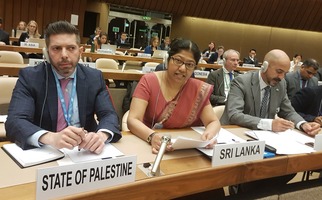
As we pursue Sustainable Development targets with an objective to ‘leave no one behind by 2030’, it is becoming apparent that the kind of impact technology and AI can make in realising the 17 SDG’s and its 169 targets, the CDA a.i. of the Permanent Mission of Sri Lanka to UN, Mrs. Samantha Jayasuriya said addressing the Meeting of the Group of Governmental Experts (GCE) on Emerging Technologies in the areas of Lethal Autonomous Weapon Systems (LAWS) held in Geneva on 9th April 2018. The use of AI to automate UNDP’s Rapid Integrated Assessment (RIA) systems, which helps in determining a country’s readiness for implementation of the Global Development Agenda, and in building interlinkages among national and sectoral policies is clearly, among one of the many positive narratives of the peaceful application of AI, she noted.
Highlighting that there are several challenges before the GGE, Sri Lanka stated that a careful study of different definitions available so far, and an objective consideration of the language used in different national defence doctrines could serve as the first step in finding a ‘working definition’ for LAWS. The degree to which AI has already been built into military weapons systems and the accepted degree of autonomy related to the critical functions of these weapons, the ‘predictability’ of their functions and the ‘reliability’ of its operations under changing conditions during a conflict is another challenge. Also, the difficulty of the ‘attribution of accountability’ is getting blur with the use of AI in military weapons systems. Nevertheless, the test of public conscience and laws of humanity as referred to in the Martens Clause should guide the Member States, even if any IHL principles are founded to be inapplicable, Sri Lanka stated.
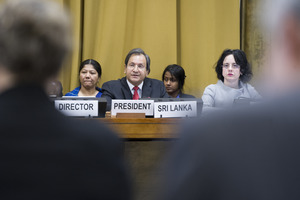
Permanent Representative of Sri Lanka to UN in Geneva, Ambassador Ravinatha Aryasinha has said "Sri Lanka makes its best contributions to the international community when it leads from the centre", rather than positioning itself in a manner "either to be taken for granted, or to remain isolated".
The Ambassador who this week relinquishes his tour of duty as Sri Lanka's Permanent Representative to the UN in Geneva, made this observation in his farewell address to the Conference on Disarmament (CD) on 27th March 2018, where last month under Sri Lanka's Presidency, the Conference unanimously adopted Decision CD/2119 setting up 5 subsidiary bodies to commence substantive work. Addressing the High-Level Segment of the CD, UN Secretary-General António Guterres welcoming this Decision stated, “I believe you are off to the best start in nearly two decades, and I look forward to building on this new momentum”.
Recalling that for long years Sri Lanka had been an active player in the field of disarmament, Ambassador Aryasinha expressed satisfaction that Sri Lanka was once again able to make a meaningful contribution through CD/2119 during its recent Presidency, notwithstanding the challenging global environment we live in today. He said the decision "was a balance between flexibility and safeguards, and it offered a framework for a more focused and continued debate on all core issues on the CD agenda. “I believe this has the potential of being an irreversible first step in getting the CD back to work, and in asserting its credibility as the single multilateral forum for negotiating disarmament treaties" he said.
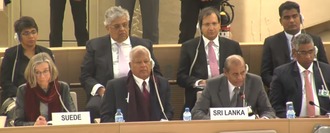
Minister of Foreign Affairs of Sri Lanka, Hon. Tilak Marapana, PC., MP, addressed the 37th session of the UN Human Rights Council (UNHRC) following the presentation of the report of the Office of the United Nations High Commissioner for Human Rights (OHCHR) on Sri Lanka by Ms. Kate Gilmore, the Deputy High Commissioner for Human Rights at the Palais des Nations in Geneva, today 21 March 2018.
Hon. (Dr) Sarath Amunugama, Minister of Special Assignments, Hon. Faiszer Musthapha, Minister of Provincial Councils and Local Government, Ambassador Ravinatha Aryasinha, Permanent Representative of Sri Lanka to the UN in Geneva, Mr. Mano Tittawella, Secretary General, Secretariat for Coordinating Reconciliation Mechanisms (SCRM), Mr. A.L.A. Azeez, Addl.Secretary/EU, Commonwealth and Multilateral Treaties of the Ministry of Foreign Affairs, Mr. Nerin Pulle, Deputy Solicitor General, Attorney General’s Department, Mrs. Samantha Jayasuriya, the Deputy Permanent Representative of Sri Lanka to the UN, Ms. Mahishini Colonne, Director General/UN, US and Canada of the Ministry of Foreign Affairs, Prashanthi Mahindaratne, Advisor to the Hon. Prime Minister and the diplomatic officers of the Permanent Mission of Sri Lanka to the UN in Geneva were associated with the Foreign Minister.
Full Statement by the Hon. Minister of Foreign Affairs
Festina Lente document as at 20 March 2018
Permanent Mission of Sri Lanka to UN in Geneva
21 March 2018
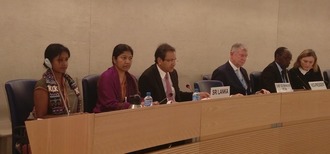
The adoption of the Universal Periodic Review Report on Sri Lanka took place this afternoon at the Human Rights Council in Geneva. Sri Lanka was represented by Permanent Representative Ambassador Ravinatha Aryasinha and assisted by the Deputy Permanent Representative Mrs. Samantha Jayasuriya.
The Statement made by Ambassador Aryasinha
Permanent Mission of Sri Lanka to UN in Geneva
19 March 2018
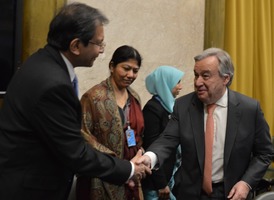
The Decision arrived at during Sri Lanka’s Presidency of the Conference on Disarmament (CD) to resume substantive work, and the role played in this regard by Sri Lanka's Permanent Representative to the UN in Geneva Ambassador Ravinatha Aryasinha, has been commended during the High-Level Segment of the CD held in Geneva this week.
In his address to the CD on Monday (26 February 2018), the UN Secretary-General (UNSG) Antonio Guterres, referred to the recent Decision of 16 February 2018 as an effort “to find ways to break the long-standing stalemate in this Conference". He further said “I believe you are off to the best start in nearly two decades, and I look forward to building on this new momentum”.
At a follow-up meeting held on the sidelines of the High-Level segment, UNSG’s High Representative for Disarmament Affairs Izumi Nakamitsu said she was "deeply impressed and grateful for the leadership offered by Ambassador Aryasinha in adopting the Decision which is a contribution not only to the CD, but also towards the overall objective of disarmament". She requested Sri Lanka to help with the immediate next steps in the implementation of the recent CD Decision.

At the invitation of the Government of Sri Lanka, the Special Envoy of the Anti-personnel Mine Ban Convention, Prince Mired Raad Zeid Al-Hussein of Jordan will undertake an official visit from 5 – 7 March 2018.
The visit is of particular significance since Sri Lanka acceded to the Anti-personnel Mine Ban Convention on 13 December 2017 becoming its 163rd State Party. The ‘Convention on the Prohibition of the Use, Stockpiling, Production and Transfer of Anti-Personnel Mines and on Their Destruction’, typically referred to as the ‘Ottawa Convention’ or ‘Mine Ban Treaty’, seeks to end the use of anti-personnel landmines (APLs) worldwide. It was opened for signature on December 3, 1997, and it entered into force on March 1, 1999. Currently the convention has 164 state parties.
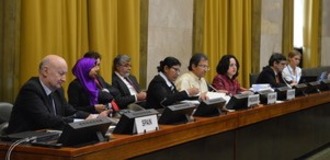

The Conference on Disarmament (CD) presided over by Sri Lanka's Permanent Representative to the UN in Geneva, Ambassador Ravinatha Aryasinha, on Friday (16 February 2018), adopted a Decision to establish five subsidiary bodies to discuss all items in its agenda, with a view to advance the substantive work of the Conference. The Decision described as a "well-brokered balance between flexibility and safeguards and offered a framework for a more focused and continued debate on core issues", seeks to bring the CD back to its original mandate of negotiating disarmament instruments. Since its negotiation of the Comprehensive Nuclear-Test-Ban Treaty (CTBT) in 1996, the CD is yet to negotiate any new treaty.
In a statement released the same evening in New York, the Spokesman for the UN Secretary-General Antonio Guterres, said "the Secretary-General welcomes the decision adopted today by the Conference on Disarmament to take forward its substantive work. The Secretary-General commends the Members of the Conference for achieving this positive step, which he hopes will lead to resumption of negotiations on effective measures for disarmament and arms control. The current international security situation underscores the vital need to restore disarmament as an integral component of our collective efforts to prevent armed conflict and to maintain international peace and security". It added that "the Secretary-General urges Member States to make use of this opening, redouble their efforts and forge a new consensus for disarmament".