

"We need to look at how best multilateralism can be advanced and strengthened rather than at theories that suggest a ‘doomsday’ scenario or the ‘dawn of an era of post-multilateralism", said Ambassador A.L.A. Azeez, Permanent Representative of Sri Lanka to UNO in Geneva. He made these remarks following his election by acclamation as the Chairperson of the 10th Session of the UNCTAD Trade and Development Commission today. Addressing the opening session, he stated “UNCTAD is an innovative platform where both theories and practices are analysed and pathways and options identified, to help guide nations in their search for solutions to trade and development constraints and challenges”.
The newly elected Chairperson of the UNCTAD Trade and Development Commission stressed that Member States needed to look ahead and bring out aspects of Stratergeis, during the week-long deliberations in the Commission, that could help countries achieve progress in SDGs, with a particular emphasis on making trade and development a critical enabler of the realization of the aspirations of people everywhere, for peace and prosperity.

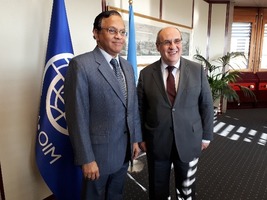
Calling on Mr. Antonio Vitorino, the new Director- General of the International organization for Migration (IOM) in Geneva, the Permanent Representative of Sri Lanka to UNO, Ambassador A.L.A. Azeez, stressed that Sri Lanka's long standing ties with IOM pre-dated its membership in that Organization, and assured continued cooperation and active support both in bilateral context as well as within multilateral fora, particularly at a time when the IOM was preparing to assume new responsibilities as the coordinator of the Global Migration Network with secretarial function for the Global Compact for Migration (GCM).
Director-General Vitorino, welcoming Sri Lanka's active contribution to the common cause of global migration governance, particularly through leadership to the Colombo Process and now as the Chair-in-Office of the Abu Dhabi Dialogue (ADD), stated that as vibrant Regional Consultative Processes (RCPs), the Colombo Process and ADD had enriched the content of the final outcome of the GCM. He expressed hope that Sri Lanka would continue this role, building upon the achievements made, to be a strong advocate for effective implementation of the GCM, during the Marrakesh High Level Meeting in December 2018, and also invited Sri Lanka to announce joint projects and proposals that could be supported by donor funding. He emphasized the importance of high-level participation at the Marrakesh Meeting.
Ambassador Azeez remarked that the IOM enjoyed wide recognition in Sri Lanka as a UN Related Agency and that the IOM country office has been closely working with the relevant Sri Lankan agencies. He requested IOM’s support for enhancing Sri Lanka's labour mobility options, particularly through capacity and skills development, noting the need for economic and social empowerment of youth and women.
The new IOM Country Representative- designate for Sri Lanka, Mr.Sarat Dash, and the IOM Advisor for Asia and the Pacific Ms. Wen Li were associated with DG- IOM, while Deputy Permanent Representative Mrs. Samantha Jayasuriya joined Ambassador Azeez at the meeting.
Permanent Mission of Sri Lanka to UN
Geneva
9 November 2018
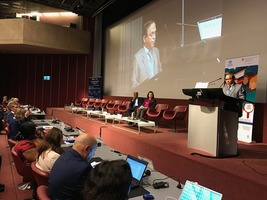
The WHO Global Coordination Mechanism for the prevention and control of Non-Communicable Diseases (GCM/NCD) concluded its General Meeting in Geneva on 6 November 2018. The two- day Conference brought together delegates and activist from Member States, UN organizations, and non-State Actors. The participants along with other stakeholders from the private sector, philanthropic foundations, and academic institutions, discussed means and modalities of strengthening the implementation of the SDG Agenda- 2030 and follow-up on the Political Declaration adopted at the Third High-level Meeting of the General Assembly in September 2018 on the prevention and control of NCDs.
Under the co-chairmanship of Ambassador Azeez, Permanent Representative of Sri Lanka, and the Representative of the host country, Switzerland, the Meeting facilitated stakeholder interactions at policy and political levels, regarding enhancing the effective coordination of prevention and control-related activities. The continued importance of multidisciplinary and multisectoral engagement, aimed to promote implementation of the WHO Global NCD Action Plan 2013-2020, and SDG 3.4 - NCD-related targets, was emphasized as was the need for building upon the existing networks of stakeholders bringing in industries, research institutions and local government bodies. A primary objective of the GCM was to assess and renew commitments that had emerged from the recently held UN High-level Meeting of the General Assembly, and its preceding High-level Conferences in 2011 and 2014.
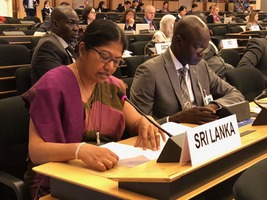
“Having dealt with issues related to internal displacement and refugee returnees, Sri Lanka recognizes the challenges associated with return and reintegration,’’ stated Deputy Permanent Representative of Permanent Mission of Sri Lanka in Geneva, Ms. Samantha Jayasuriya, participating at the just concluded General Debate of the 69th Session of the Executive Committee (Ex-Com) of the UNHCR in Geneva.
She noted that the Global Compact for Refugees (GCR), agreed recently following consultations in Geneva, was aimed at addressing large scale movements of refugees, but given that most movements were 'mixed flows', who were using the same routes and encounter similar needs and challenges, it was important that it must be responded to effectively at the ground level.
Sri Lanka delegate commended the agreement on GCR as a triumph for multilateralism while thanking the UNHCR and the country teams of UN agencies working in Sri Lanka for complementing the efforts of the Government. Sri Lanka reiterated its commitment to continuing its constructive engagement with the UNHCR.
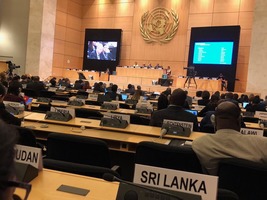
The High Commissioner for Refugees Mr. Filippo Grandi conveyed his appreciation to Sri Lanka for drawing attention of the Ex-Com to the needs and challenges of mixed migration flows, which he said was an important aspect that required collective responses at all levels.
The Executive Committee of the UNHCR is a Forum for Annual Dialogue among States Parties to the 1951 Refugees Convention and its 1967 Protocol. Its primary objective is to assess and share experiences on addressing issues related to refugees, IDPs, Statelessness and the work and finances of the UNHCR.
Permanent Mission of Sri Lanka to UNO
Geneva
2 October 2018
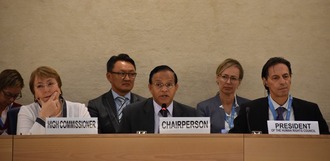
The 2018 Social Forum of the United Nations Human Rights Council kicked off today at the United Nations in Geneva, with Sri Lanka's Permanent Representative Ambassador Azeez as the Chairperson-Rapporteur, alongside High Commissioner for Human Rights Madam Michelle Bachelet and Council President Vogislav Suc. This three day Forum will address the possibilities of further promoting human rights for all and to strengthen universal respect for them, through a thematic focus.
Opening the 2018 Social Forum of UN Human Rights Council today Ambassador Azeez says 'this Forum has served as an inclusive platform for multi-stakeholders & has enabled a deep reflection, among participants, on important themes that could bring out diverse aspects of intersectionality between Human Rights and the society'.
Addressing the Social Forum further, Sri Lanka's Permanent Representative stated that at a time when every recognized norm and value on which the UN, international order, and multilateralism stand, was being put to test in today's globalized and yet volatile world, the importance of Social Forum, stands enhanced as a bridge-builder and as an enabler of an exchange of diverse perspectives aimed to strengthen and elaborate such norms and values.
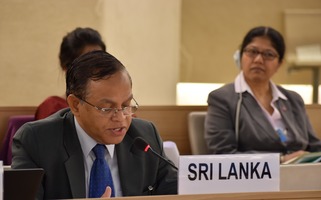
“Sri Lanka’s continuing engagement with the special procedures of the Human Right Council testifies to the priority we attach to open and candid exchanges” said Ambassador A.L.A. Azeez, Sri Lanka’s Permanent Representative to the UN in Geneva, delivering a Statement on behalf of the Government of Sri Lanka at the Human Rights Council today (12th September 2018). Participating representative of the ‘Country Concerned’ in the Clustered Interactive Dialogue with the Working Group on Arbitrary Detention at the 39th Session of the Human Rights Council, emphasized “a number of positive developments have taken place strengthening governance, rule of law and human rights as acknowledged in the report of the Working Group on Arbitrary Detention”. The Statement followed the presentation of the Report (A/HRC/39/45/Add.2) on the visit of Working Group on Arbitrary Detention to Sri Lanka from 4th to 15th December 2017.
Permanent Mission of Sri Lanka
Geneva
12th September 2018
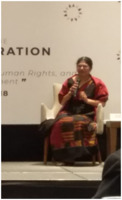
Sri Lanka participated at the Manila Conference on 'Future of Migration', and joined panel discussion sharing experience as the current Chair of the Abu Dhabi Dialogue.
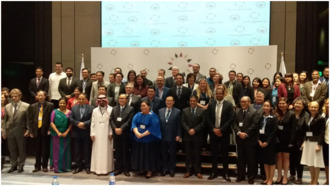
Statement delivered by Samantha Jayasuriya
Sri Lanka Permament Mission
Geneva