
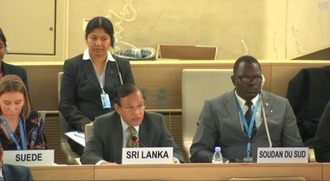
"Sri Lanka has steadfastly pursued economic, social and cultural advancement as a developing country, with the same emphasis and thrust as for protection of civil and political rights" since becoming a State party to the covenants on civil and political rights, and economic, social and cultural rights, said Ambassador A.L.A. Azeez, Sri Lanka’s Permanent Representative to the UN in Geneva, today, 28 February 2019, at the 40th Session of the Human Rights Council.
Participating as the "Country Concerned" at the Clustered Interactive Dialogue (ID) with the Independent Expert on the effects of foreign debt and other related international financial obligations of States on the full enjoyment of all human rights, particularly economic, social and cultural rights and Special Rapporteur on the right to food, Ambassador Azeez emphasized that poverty alleviation remained a high priority for the Government of Sri Lanka. "A holistic approach is being followed in addressing poverty and advancing national development" he further added.
The Statement followed the presentation of the Report (A/HRC/40/57/Add.2) on the visit of Independent Expert to Sri Lanka from 3rd to 11th September 2018. Sri Lanka's observations on the Report of the Independent Expert are contained in document A/HRC/40/57/Add.4.
Full Statement
Permanent Mission of Sri Lanka
Geneva
28 February 2019
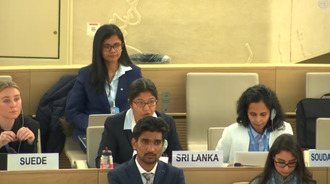
Addressing the Annual High-level Panel Discussion on Human Rights Mainstreaming on 25 February 2019, Sri Lanka said that having actively engaged in a number of inter-governmental processes and observing the overwhelming desire of the stakeholders to build consensus and collective outcomes over the last several years, it believed that the “picture is not entirely bleak”, and “there is still hope that multilateralism can deliver despite challenges”.
Sri Lanka's Deputy Permanent Representative in Geneva Mrs. Samantha Jayasuriya stated so, speaking on the theme ‘Human Rights in the light of multilateralism: opportunities, challenges and the way forward’, during the ongoing 40th Session of the Human Rights Council in Geneva.
Making further comments, Mrs. Samantha Jayasuriya said the high-level panel discussion came at a time when there were broader concerns on whether the UN multilateral system was able to respond effectively, to a rapidly changing global peace, security and development architecture. She noted that in the recent years, the multilateral outcomes reached through the Paris Climate Change Summit, the Marrakech Global Migration Compact, the 2030 Agenda for Sustainable Development, to name a few, had taken a human centric approach, integrating human rights and transforming them into actionable commitments. She stressed, however, that it was time to take a critical look on how and what more could be done to improve UN multilateral processes.
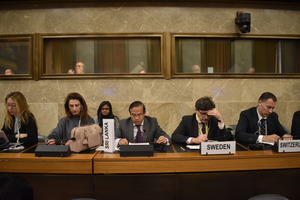
"We need to seriously attempt at negotiating a Programme of Work for nuclear disarmament and non-proliferation", stated Sri Lanka's envoy in Geneva Ambassador A.L.A Azeez addressing the Plenary Session of the UN Conference on Disarmament (CD). He urged members of the CD to find a way forward that could facilitate, or create momentum for, work on all core issues.
The Permanent Representative of Sri Lanka assured Sri Lanka's fullest support for all efforts towards generating consensus within CD, building upon the outcome achieved under Sri Lanka's presidency of the disarmament forum last year.
Ambassador Azeez highlighted the importance of CD being representative enough of the whole range of views and perspectives on critical issues in the disarmament and non-proliferation arena. In this context, he streesed that education and training in disarmament and non -proliferation and integration of a gender perspective were necessary to help advance fully informed, well represented, result oriented negotiation on critical issues.
Noting the stalemate in launching substantive negotiations, he asserted that 'Rules of Procedure should aid, not prevent, deliberations on substantive issues'.
He further urged delegations to take a hard look at the challenges that lay ahead, and to consider taking a constructive approach to negotiating a programme of work without further delay.
Full Statement by Ambassador Azeez
Sri Lanka Permanent Mission
Geneva
20 February 2019
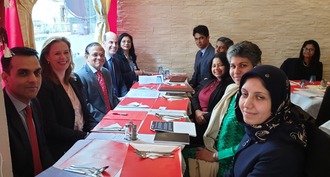
At a luncheon gathering today (30.01.2019) of European Organization for Nuclear Physics (CERN) representatives & South Asian diplomats hosted by Sri Lanka, Ambassador Azeez emphasized the importance of networking between South Asian scientific community and CERN, as well as among scientific communities in the wider region. He said this would enable scientific advances to enhance South Asian countries' individual and collective capacities to contribute to the effective realization of SDGs and the empowerment of all people.
The second South Asian High Energy Instrumentation Workshop (SAHEPI - 2) will take place in Sri Lanka from 20 - 21 February 2019, co-hosted by Ministry Science, Technology and Research and CERN.
Permanent Mission of Sri Lanka
Geneva
30th January 2018
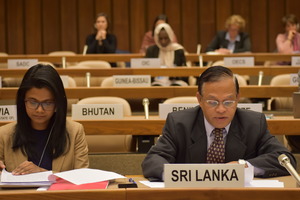
At the 2019 Global Appeal of the United Nations High Commissioner for Refugees (UNHCR) held in Geneva today, Sri Lanka expressed its earnest desire that the commitments made by the international community to the recently adopted Global Compact on Refugees (GCR) would remain on course, emphasizing “transforming the Compact into meaningful, practical measures would help address the protection needs of millions of people who remain helpless and in need”.
Addressing the Conference, Ambassador A.L.A. Azeez, the Permanent Representative of Sri Lanka in Geneva echoed optimism that, at a time when “the principles and values of international cooperation have come under immense pressure”, “the GCR has emerged as a rallying point for multilateralism and solidarity”, as reiterated in the UNHCR’s Global Appeal Update, and highlighted the more pronounced role of UNHCR in this context.
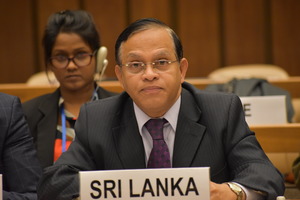
Addressing the Meeting of State Parties to the Biological Weapons Convention (BWC), Ambassador A.L.A. Azeez, Sri Lanka Permanent Representative in Geneva, stated that Sri Lanka accorded high priority to the effective implementation of the BWC - the first multilateral treaty to ban an entire category of weapons of mass destruction. Continuing drive towards universalization of this important Convention, he stressed, would strengthen the efforts of the international community against the use or threat of use of biological agents or deliberate use of diseases in breach of peace and security.
Elaborating national implementation measures and efforts under BWC, he referred to the Strategic Plan on Antimicrobial Resistance under 'One Health" concept in Sri Lanka. He further stressed that learning from the experiences of States Parties and sharing of good practices was important, and that such an inclusive approach would contribute to further improving policy and legal frameworks.
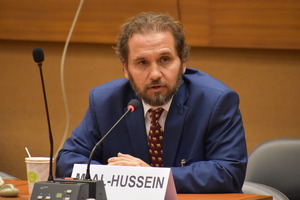
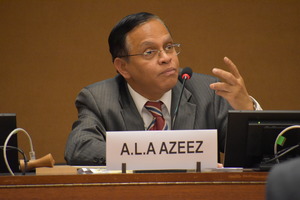
During my visit to Sri Lanka I saw extraordinary seriousness from the higher political level, down to official level to make Sri Lanka mine free by 2020’’, stated His Royal Highness Prince Mired Bin Ra’ad Bin Zeid Al-Hussein, the Special Envoy of the UN Secretary General promoting universalization of the Ottawa Convention, at a Panel Discussion, chaired by Sri Lanka Permanent Representative, Ambassador A. L. A. Azeez, in Geneva on 30th November 2018. He addressed a gathering of Ambassadors, delegates, civil society and other volunteers participating in the ‘Mine Free Sri Lanka 2020’ event, co-organized by the Permanent Mission of Sri Lanka in Geneva, and the Sri Lanka Campaign to Ban Land Mines.
The event took place on the sidelines of the 17th Meeting of States Parties (17 MSP) to the Convention on the Prohibition of the Use, Stockpiling, Production, and Transfer of Anti-Personnel Mines and on their Destructions’. Commending the commitment of Sri Lanka and all its implementing partners, Prince Mired lauded Sri Lanka’s progress as ‘a unique example’.
Making opening remarks as the Chair of the Panel, Ambassador Azeez stressed “the tremendous amount of work that was done on the ground, paving the way for the release of land and the resettlement of affected persons, makes the case of Sri Lanka distinct from other situations elsewhere’’.