
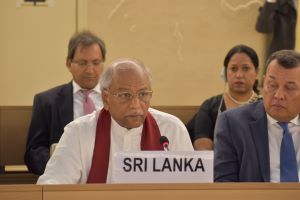
Agenda Item 2 General Debate: Presentation of the written update on the implementation of HRC Resolution 30/1 by the High Commissioner for Human Rights pursuant to HRC resolution 40/1, OHCHR Report on ‘Promoting reconciliation, accountability and human rights in Sri Lanka’ (A/HRC/43/19)
27 February 2020
Statement by Hon. Dinesh Gunawardena, Minister of Foreign Relations, Skills Development, Employment and Labour Relations of Sri Lanka
Madam President,
Madam High Commissioner,
Members of the HRC and Delegates to the 43rd Session of HRC,
Ladies and gentlemen,
As this Council deliberates on the written update presented by the High Commissioner on progress regarding the implementation of HRC Resolution 30/1, I wish to reiterate that Sri Lanka remains committed to engaging with the High Commissioner and her Office in achieving sustainable development, peace and reconciliation, within the national framework overwhelmingly approved by the people of Sri Lanka during the Presidential Election last November, where President Gotabaya Rajapaksa was elected with an overwhelming majority.
Yesterday, the Government of Sri Lanka, at the High Level Segment made clear it’s position with regard to HRC Resolution 30/1, particularly, its decision to withdraw from co-sponsorship of Resolution 40/1 of March 2019, which also incorporates and builds on preceding Resolutions 30/1 of October 2015 and 34/1 of March 2017.
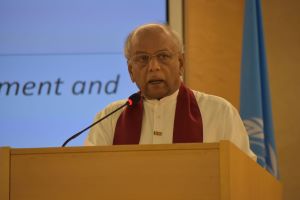
43rd Session of the Human Rights Council – High Level Segment
Madam President
Madam High Commissioner
Ladies and gentlemen,
As this Council is aware, in November 2019, the people of Sri Lanka gave a resounding mandate to President Gotabhaya Rajapaksa, to pursue a policy framework aimed at achieving the “four-fold outcome of a productive citizenry; a contented family, a disciplined, a just society and a prosperous nation”[1]. It is envisaged to achieve sustainable development and peace in the country, firmly anchored in safeguarding “national security without compromising the democratic space available to our people”[2].
It was over a decade ago, on 18 May 2009, that Sri Lanka defeated LTTE terrorism militarily, bringing to an end three decades of conflict and suffering. The end of the brutal conflict advanced, secured and protected one of the fundamental human rights – the ‘right to life’ for all Sri Lankans- Sinhalese, Tamil, Muslims and others. I would like to state with pride that since May 2009, not a bullet has been fired in the name of separatist terrorism in Sri Lanka.
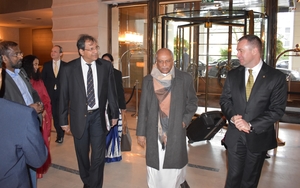
Minister of Foreign Relations, Skills Development, Employment and Labour Relations – Dinesh Gunawardena who leads the Sri Lanka delegation to the 43rd Session of the Human Rights Council arrived in Geneva a short while ago.
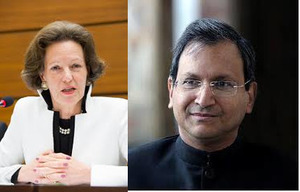
Ahead of the upcoming 43rd Session of the Human Rights Council (HRC) scheduled to commence next Monday (24 February), Foreign Secretary Ravinatha Aryasinha briefed the President of the HRC Ambassador Elisabeth Tichy-Fisslberger on the decision of the Government of Sri Lanka to withdraw its co-sponsorship of Resolution 40/1 of March 2019 on ‘Promoting reconciliation, accountability and human rights in Sri Lanka’, which also incorporates and builds on preceding Resolutions 30/1 of October 2015 and 34/1 of March 2017.
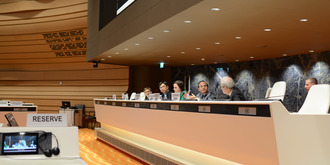
Ambassador A.L. Abdul Azeez, Sri Lanka’s Permanent Representative to the United Nations Office at Geneva recently chaired a panel at the Debt Management Conference organized by the United Nations Conference on Trade and Development (UNCTAD). This conference, which is organized every two years by the UNCTAD provides a regular forum for sharing experiences and exchanging views between Governments, international organizations, academia, the private sector, and civil society on current issues in public finance, debt management and the debt crisis prevention.
This year’s Debt Management Conference brought together senior-level national and international debt managers and experts from around the world to discuss some of the most pertinent topics in both external and domestic debt, debt management and public finance.
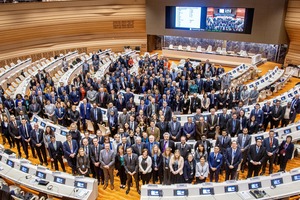
Sri Lanka's Permanent Representative to the UN in Geneva Ambassador A.L.A. Azeez takes over the Chairmanship of the 2020 States Parties' Meeting from Ambassador Yann Hwang of France, the outgoing Chair.
Sri Lanka's chairmanship, as the Convention marks 45 years of its entry into force next year and as the State Parties convene throughout 2020 a series of expert meetings and preparatory meetings building up towards the Ninth Review Conference in 2021, is highly significant for strengthening international cooperation and assistance to fully realise its objectives alongside universalisation and sustained focus on national implementation.
The Convention on the Prohibition of the Development, Production and Stockpiling of Bacteriological (Biological) and Toxin Weapons and on their Destruction, popularly known as Biological Weapons Convention (BWC) prohibits biological and toxin weapons through their entire cycle, and is a key element in the international community’s efforts to address the proliferation of weapons of mass destruction and States Parties’ endeavours to improve national security in an increasingly volatile global environment.
Permanent Mission of Sri Lanka
6th December 2019
Geneva
Convention on Prohibitions or Restrictions on the Use of Certain Conventional Weapons Which May be Deemed to Be Excessively Injurious or to Have Indiscriminate Effects (CCW)
Meeting of High Contracting Parties
General Exchange of Views – 13 November 2019
Statement by Sri Lanka
Mr. President,
It is with great pleasure and warmth that Sri Lanka welcomes you to Geneva and joins in congratulating you on your appointment as the President of this year’s Meeting of High Contracting Parties to the CCW. We commend the leadership provided by Pakistan to the CCW process in the run up to this Meeting, as it did during the CCW Review Conference of 2016 as well. We also take this opportunity to applaud Benin on acceding to Protocols II, IV and V in 2019, further strengthening its commitment to the cause of the CCW.
Mr. President,
As a country successfully emerging from the effects of long-term conflict, Sri Lanka appreciates and underlines the pronounced need for humanitarian disarmament and arms control. Norms of humanity and related principles of international humanitarian law, including proportionality, inform discourses on regulation, control and eventual elimination of weapons that are excessively injurious. Following years of humanitarian demining work that was undertaken even as the conflict was raging, we are now inching closer to making Sri Lanka landmines-free in the near future. Through sustained national efforts at mine risk education, we also succeeded in bringing civilian casualties of landmines, to zero by 2018.
- Policy of ‘Leave No One Behind’ in development must resonate at all levels, Sri Lanka tells WHO Heath Forum
- 70th session of the Executive Committee of the High Commissioner’s Programme (ExCom) of UNHCR
- Sri Lanka highlights the importance of education in the promotion and protection of the rights of children and youth