

45th Session of the Human Rights Council
Item 5: Interactive dialogue with the Assistant Secretary General for Human Rights on the report of the Secretary-General on co-operation with the United Nations, its representatives and mechanisms in the field of human rights
30 September 2020
Statement by Sri Lanka
Madam President,
The Government of Sri Lanka (GoSL) wishes to make the following observations with regard to the reference contained in the Annual Report of the Secretary-General on "Cooperation with the United Nations, its representatives and mechanisms in the field of human rights", presented to this Council:
With regard to alleged “intimidating visits”, “surveillance”, complaints of harassment” and “reprisals” referred to in the Report, the GoSL wishes to make an invitation to the parties concerned to make formal complaints to law enforcement authorities or to independent national institutions such as the Human Rights Commission of Sri Lanka or the National Police Commission, so that action can be taken to investigate the alleged incidents.
The Government has already publicly refuted these allegations, and is committed to protecting and promoting freedom of expression and civil society space, and ensure that complaints received on alleged attacks against journalists, human rights defenders and civil society are investigated and prosecuted.
It is also reiterated that, apart from operating routine security networks in the interest of national security, particularly after the devastating Easter Sunday terrorist attacks, the Security Forces and intelligence agencies are not engaged in monitoring any specific group of people in the country.
We believe that, for any country compromising its national security interests amidst looming sophistication of strategies of radical and extreme elements world around, is bound to face regrettable consequences. Hence, the GoSL requests all parties to be mindful of that ground reality in this context.
45th Session of the Human Rights Council
Item 7: General Debate on the human rights situation in Palestine and other occupied Arab territories, during the 45th session of the UN Human Rights Council
30 September 2020
Statement by Sri Lanka
Madam President,
Sri Lanka aligns itself with the statement delivered by the Non Aligned Movement.
Sri Lanka’s long held principled position on this matter has been clear. We recognize the legitimate and inalienable right of the people of Palestine to statehood and to the natural resources in their territory. Any form of annexation, irrespective of its size, would constitute a violation of international law, jeopardize prospects for a peaceful settlement to the issue and cause destabilization of peace and security in the Middle East region.
Recent UN reports, including by the Secretary General, have indicated continued human rights violations of the Palestinian people in the OPT. We therefore urge Israel to abandon completely its annexation plans as well as similar activities, and respect the rights of the Palestinian people to fundamental freedoms and security. We echo the expectation of the Secretary General that the recent agreement would lead to an opportunity for re-engagement for constructive and meaningful negotiations to resolve conflict in line with the two-state solution based on relevant UN resolutions and international law.
Statements Delivered by Sri Lanka at the Meeting of the Group of Governmental Experts (GCE) on Emerging Technologies in the areas of Lethal Autonomous Weapon Systems (LAWS) held in Geneva on from 21-25 September 2020.
Agenda Item : 5(a) An exploration of the potential challenges posed by emerging technologies in the area of Lethal Autonomous Weapons Systems to International Humanitarian Law;
Mr. Chair,
Excellencies, Distinguished participants,
At the outset, Sri Lanka would like to congratulate you on your assumption of the Chair of the Group of Governmental Experts (GGE) on Emerging Technologies in the Field of Lethal Autonomous Weapons Systems (LAWS). We also take this opportunity to appreciate the former Chair of the GGE on LAWS Ambassador Kārkliņš, for his commitment and efforts to continue the momentum. Let me assure you Mr. Chair, of the support of our delegation to the continuation of substantive deliberations in the GGE on LAWS during this year and in 2021.
It is unfortunate that the unexpected circumstances during this year as well as the difficulty to reach consensus on key aspects of the GGE have led to a lack of substantive progress that many of us would have expected to achieve.
Statement by the Democratic Socialist Republic of Sri Lanka
44th Session of the Human Rights Council
Item 7: ID with SR on Occupied Palestinian Territory
16th July 2020
Madam President,
Sri Lanka takes note of the report presented by Mr. Michael Lynk, Special Rapporteur on the situation of human rights in the Palestinian Territory occupied since 1967.
Sri Lanka associates itself with the statement delivered by Azerbaijan on behalf of the NAM.
We share the concerns raised by the UN Secretary General, the High Commissioner for Human Rights, UN Special Committee to Investigate Israeli Practices and the Special Rapporteur, on the planned annexation by Israel which would constitute a grave breach of international law, including the UN Charter, relevant Conventions as well as Security Council and General Assembly resolutions.
Agenda Item 3: Interactive dialogue with the Special Rapporteur on the rights to freedom of peaceful assembly and of association
09 July 2020
Statement by Sri Lanka
Mr. Vice President,
Sri Lanka thanks Mr. Clément Nyaletsossi Voule, Special Rapporteur on the rights to freedom of peaceful assembly and of association for the report on his visit to Sri Lanka from 18-26 July 2019 (A/HRC/44/50/Add.1). The Government of Sri Lanka shared its comments on the contents of the Special Rapporteur’s advanced unedited report, some of which have been incorporated into the final version that has been presented today. At this interactive dialogue, we wish to share some further comments on matters contained in the report, and provide updates where available.
Mr. Vice President,
As acknowledged by the Special Rapporteur in his Report, the Government of Sri Lanka extended full cooperation and support to the Special Rapporteur “before, during and after the visit, especially given the great difficulties presented at the time”, demonstrating commitment to engage constructively and meaningfully with the Special Rapporteur.
We take note of the recognition in the report, of Sri Lanka’s “particular circumstances as a post-conflict and multi-ethnic society”, and the Special Rapporteur’s condolences to the victims of the Easter Sunday terrorist attacks.
The facilitation of the Special Rapporteur’s visit, even as the country was grappling with challenges associated with a new manifestation of terrorism, demonstrates Sri Lanka’s commitment to continue its constructive engagement with UN human rights mechanisms. The visit of the Special Rapporteur was among the 9 country visits undertaken by Special Procedure Mandate Holders on different thematic mandates to Sri Lanka in the past 5 years, and we remain committed to fostering this cooperative dialogue.
Statement by the Democratic Socialist Republic of Sri Lanka
44th Session of the Human Rights Council
Agenda Item 3: Interactive Dialogue with Special Rapporteur on the human rights of migrants
06 July 2020
Madam President,
Sri Lanka welcomes the report presented by the Special Rapporteur on the human rights of migrants.
The contribution of migrant workers to economic growth and development is increasingly becoming critical not only for their own countries, but also as a catalyst for the upward socio-economic mobility in the region and internationally.
We believe that the COVID-19 crisis taught the world that coordinated and concerted efforts are needed to ensure that migrant health is addressed without discrimination throughout the migration cycle. A further consequence of Covid-19 has been the shrinking of the employment market, which could lead to a serious shortfall in the numbers of migrant workers who will leave for work this year and in turn a drop in worker remittances.
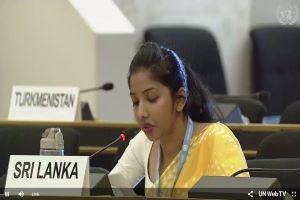
Statement by the Democratic Socialist Republic of Sri Lanka
44th Session of the Human Rights Council
Agenda Item 3: Interactive dialogue with Special Rapporteur on the Right of Everyone to the Enjoyment of the Highest Attainable Standard of Physical and Mental Health
06 July 2020
Madam President,
Sri Lanka welcomes the report presented by the Special Rapporteur on the right of everyone to the enjoyment of the highest attainable standard of physical and mental health. We believe this is timely given that the COVID-19 pandemic is affecting both the physical and mental health of the peoples around the world in an unprecedented manner.
According to WHO statistics, the leading cause of death among young people aged 15-29 has been identified as suicide and most causes are both preventable and treatable. It is distressing that every 40 seconds, someone is dying of suicide somewhere in the world.
It is important to ask what kind of concerns mental health issues cause for humanity and what must be done to address this challenge as we pursue a policy of 'leaving no one behind' in advancing the UN development agenda- 2030, and specially SDG 3 - Good Health and Well-being.
- 44th Session of the Human Rights Council Agenda Item 2: Interactive dialogue on the annual report of the High Commissioner 02 July 2020
- Statement by Sri Lanka at the 43rd session of the Human Rights Council on racially inspired human rights violations against people of African descent,17 June 2020
- Statement by Sri Lanka at the resumed 43rd session of the Human Rights Council under Agenda Item 7: Human rights situation in Palestine and other occupied Arab territories, 15 June 2020 (2)