

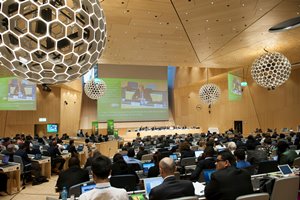
Permanent Representative of Sri Lanka to the UN in Geneva, Ambassador Ravinatha Aryasinha said Sri Lanka had taken a lead in multi-lingual Internet initiatives, by putting in place technical conditions to facilitate the presence of its local languages on the Internet and encouraging the development of relevant Sinhala and Tamil content, thus ensured cultural and linguistic diversity and identity.
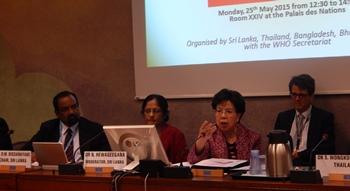
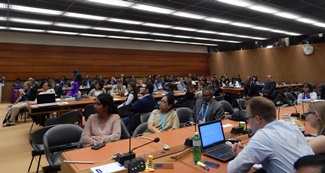
Dr. Margaret Chan, the Director General of the World Health Organization (WHO) has said "“Pictorial warning is the most cost effective means of controlling tobacco related Non Communicable Diseases (NCDs), including cancer “, and that "countries can get return on their investment in multiple areas". Paying tribute to countries including Sri Lanka whom she said "had the courage to keep going despite heavy resistance by the tobacco industry", Dr. Chan said "without our joint effort, you know what effect tobacco would take. We should not allow an industry to intimidate governments, make money and leave you with all the health consequences". She urged that "the international community come together to fight the tobacco industry".
Dr. Chan made these observations when she inaugurated a session on the theme “Strategies to overcome resistance against pictorial warning messages in tobacco products”, hosted by Sri Lanka on the sidelines of the 68th World Health Assembly at the Palais des Nations in Geneva on Monday (25th May 2015).
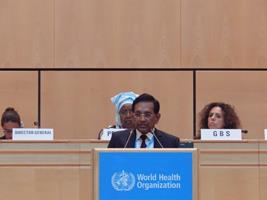
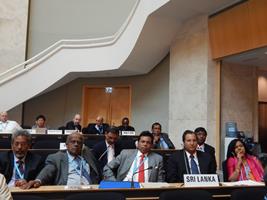
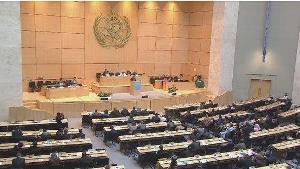
Minister of Health and Indigenous Medicine Dr Rajitha Senartne today (19 May 2015) addressed the 68th World Health Assembly held in Geneva and highlighted the progress Sri Lanka has made in achieving the Millennium Development Goals and universal health coverage, particularly with respect to Maternal & Child Health and the control of communicable diseases.
Highlighting the health scenario in the country he said that under the guidance of President Maithripala Sirisena, the country is poised to enter a new phase of health development and pointed out that the health burden of the country is now moving more towards non communicable diseases, such as cardiovascular, respiratory neoplasm and diabetes, which account to over 70% of deaths.


Noting the legitimate right of the countries which have given up the nuclear-weapon option under NPT to receive legally binding security assurances against the use or threat or use of nuclear weapons under any circumstances, Sri Lanka urged countries which possess nuclear arsenals to rethink their approach towards national security in such a manner that the use of nuclear weapons is not envisaged in their national security doctrines.
Permanent Representative to the United Nations Office in Vienna, Ambassador A.L.A. Azeez made these observation on 7th May 2015 at the Main Committee I – Disarmament of the 2015 Review Conference of the Parties to the Treaty on the Non-Proliferation of Nuclear Weapons held in New York.
While noting the increasing role of the nuclear energy and nuclear technology for the socio-economic development of States, Sri Lanka expressed that there should be no obstacles placed on the path to peaceful uses, subject to accepted safeguard standards. Sri Lanka also noted the importance of civil nuclear cooperation, as an important tool for realising such peaceful uses by many countries.
Permanent Representative to the United Nations Office in Vienna, Ambassador A.L.A. Azeez made these observation on 7th May 2015 Main Committee III – Peaceful Uses of Nuclear Energy of the 2015 Review Conference of the Parties to the Treaty on the Non-Proliferation of Nuclear Weapons held in New York.