
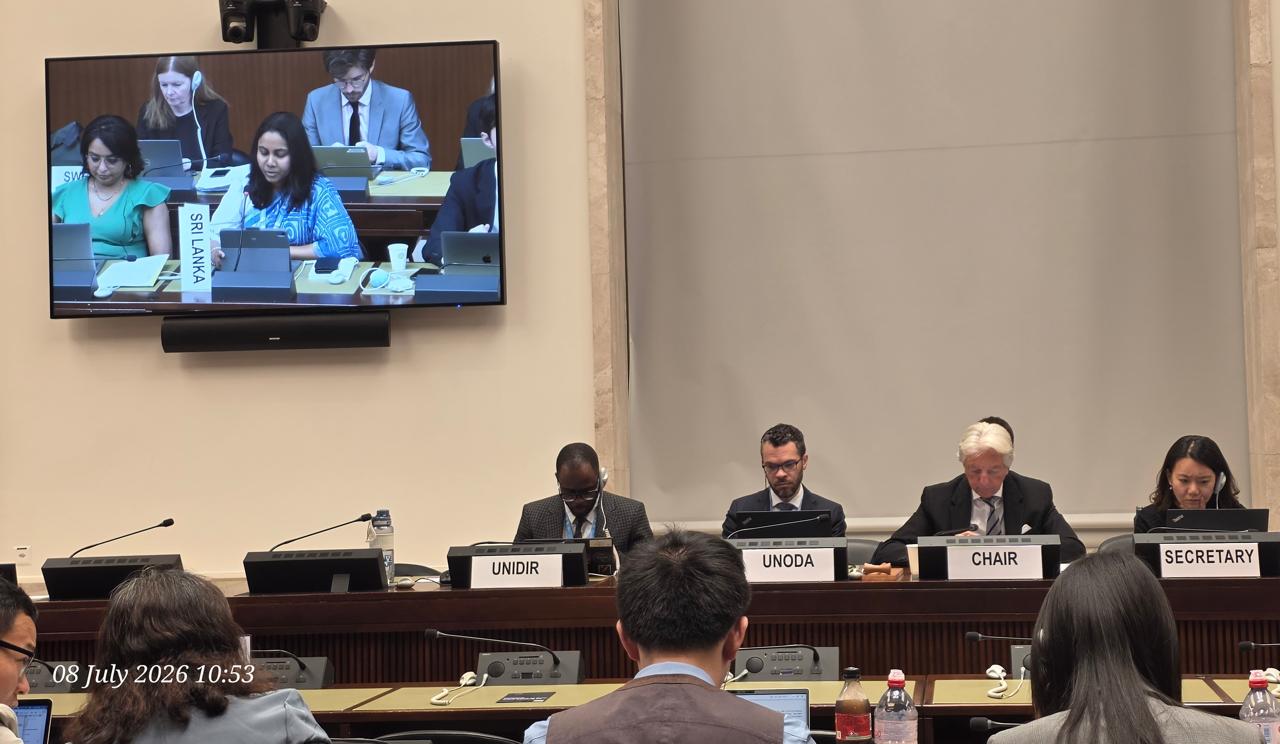
Mr. Chair,
At the outset, the delegation of Sri Lanka wishes to express deep condolences and solidarity with the people of Venezuela following the devastative impact of the recent earthquake.
Mr. Chair, since this is the first time that my delegation is taking the floor, Sri Lanka wishes to congratulate you on your continued leadership for the third session of the Open-ended Working Group.
Mr. Chair,
Sri Lanka’s approach to outer space security remains clear, consistent, and deeply rooted in our historical commitment. We reaffirm the foundational principle that outer space is the common heritage of humankind. Its exploration and use must be reserved exclusively for peaceful purposes, operating to the benefit of all peoples, irrespective of their level of economic, technological or scientific development.
We strongly believe that the activities in outer space should be guided by the principles enshrined in the UN Chater, particularly Article 2 on the prevention of threat or use of force. Further we call that all activities in outer space should align with the existing provisions of the Outer Space Treaty.
Guided by this vision, we strongly reject any militaristic approach that risks drawing humanity into a catastrophic orbit of conflict, where the consequences will not be confined to spacefaring nations but will fall heavily upon the entire global community, particularly developing nations that rely on space-based socio-economic infrastructure.
Mr. Chair,
Under this agenda item, our focus is fixed on the crucial imperative of preventing the placement of weapons in outer space. Sri Lanka has long maintained that the most effective way to address this threat is early conclusion of a comprehensive, legally binding, and multilaterally verifiable international treaty.
My delegation strongly maintains that voluntary norms, rules, and transparency and confidence-building measures (TCBMs) are useful but inherently complementary in nature and not substitute for a legally binding instrument. We believe that such measures serve as valuable interim steps to reduce mistrust and build confidence while leading to future foundational steps for a legally binding treaty architecture.
Mr. Chair, therefore, we express our support for this working group as it seeks the best outcome of these various approaches in a complementary and incremental way. To this direction, our work should be based on existing work carried out so far in the Conference on Disarmament, First Committee and other UN-led initiatives while avoiding duplications.
Mr. Chair,
To ensure that measures against the placement of weapons are both practical and enduring, my delegation wishes to highlight the following specific priorities:
First, the scope of prevention must be comprehensive. Partial measures that focus solely on the testing of specific technologies leave dangerous legal gaps. A robust prevention framework must explicitly address, and restrict the research, development, production, and deployment of all weapon systems designed for placement in orbit.
Second, any future legal instrument must feature an adaptable verification mechanism. Rapid advancements in dual-use technology and the rise of commercial space actors require verification protocols that can evolve alongside technology, supported by a clear dispute resolution framework to manage compliance equitably.
Third, legal frameworks must safeguard the access to developing states for peaceful use of outer space. The prevention of an arms race must not limit developing nations from accessing space science, technology, and data for peaceful applications such as climate monitoring, disaster management, and sustainable development.
Mr. Chair,
In conclusion, Sri Lanka has historically been a foundational pillar of prevention of arms race in outer space, notably serving as the traditional co-sponsor of the annual UN General Assembly resolution on the Prevention of an Arms Race in Outer Space (PAROS) together with Egypt.
Sri Lanka's position rests on the cardinal principle that outer space is the common heritage of humankind and must be used exclusively for peaceful purposes.
My delegation stands ready to work constructively with all delegations to achieve these shared goals.
Thank you.