


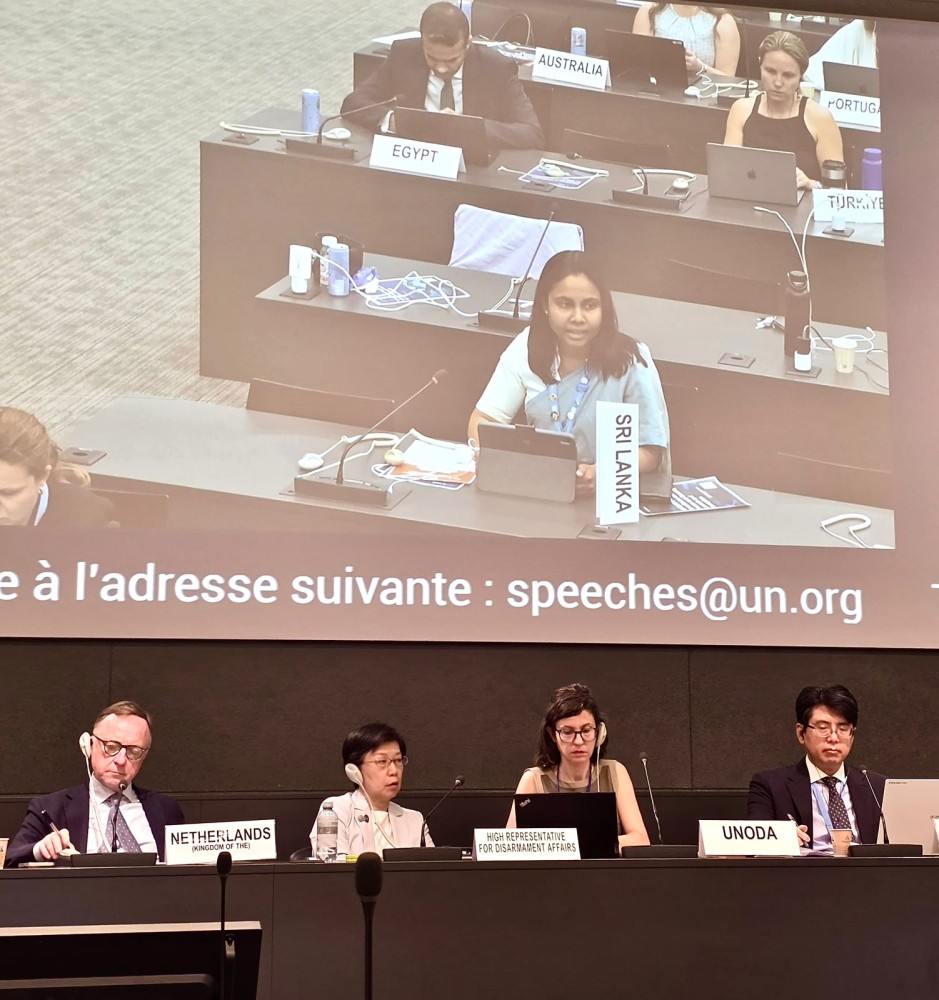
Day 2: Tuesday, 16 June 2026
Session 5 (10:00 – 11:30) The Life Cycle of AI in the Military Domain (Part 2)
As emphasized in our intervention yesterday, Sri Lanka welcomes the focus of Resolution 80/58 on the entire life cycle of Artificial Intelligence capabilities within the military domain. This must encompass every stage: from pre-design, design, development, evaluation, and testing, to deployment, use, sale, procurement, operation, and decommissioning.
Unlike conventional weapon systems, military AI capabilities demand meticulous governance from their very inception. Ensuring strict compliance with international law at every single stage of this life cycle is essential to prevent dangerous gaps in accountability regarding the use of force. Consequently, human control and unconditional compliance with International Humanitarian Law (IHL) must be legally guaranteed throughout the entire lifecycle.
The topic of human control and judgement has been extensively discussed across multiple sessions of the GGE on LAWS, Sri Lanka believes attempting to reopen this discussion within the limited timeframe of this forum is ineffective. It is vital that our work complements, rather than duplicates or overrides, the extensive work that accomplished through the GGE on LAWS.
However, the lack of a universal, legally binding mechanism to ensure human control and IHL compliance throughout the military AI life cycle remains a grave and unresolved challenge. The existing provisions under Article 36 of Additional Protocol I to the Geneva Conventions are insufficient for this purpose and moreover, they remain voluntary and non-binding. Therefore, a robust, legally binding instrument is an absolute necessity. We recognize that this task is exceptionally challenging, given the inherently dual-use nature of AI capabilities.
AI-driven Decision Support Systems (AI-DSS) are increasingly integrated into modern military architectures. These systems process vast volumes of data at speeds that far exceed human cognitive capacities. As a result, the deployment and use of force merely become pre-defined and the critical functions including ‘select and engage a target’ also becomes pre-defined results of the pre-design and design phases. This makes the attribution of legal accountability exceptionally complex. This challenge is further intensified by the evolving nature of machine learning and the "black-box" nature of these algorithmic systems.
To be clear, AI-Decision Support Systems cannot replicate the legal reasoning required by IHL. These systems fundamentally fail to weigh the contextual, qualitative and value-laden dimensions inherent to human judgment in armed conflict. Because machine learning directly undermines the ‘explainability’ and ‘predictability’ of autonomous systems and completely breaks the chain of accountability established against IHL violations.
Therefore, instead of becoming trapped in narrow debates over hardware and software configurations, we must return to the very spirit of the Geneva Conventions and apply those core humanitarian principles directly to AI Decision Support Systems.
In conclusion, Sri Lanka stands firmly to advocate for legally binding instruments to ensure that a human-centric approach and compliance with IHL is legally enforced across the entire AI life cycle.
Thank you
Day 3: Wednesday, 17 June 2026
Session 12 (15:00 – 17:00): Next Steps on AI in the Military Domain
Under Secretary-General and High Representative of UN Office for Disarmament Affairs, Madam Izumi Nakamitsu,
Excellencies and collogues
The discussions over the three days have made one reality abundantly clear. The pace of military AI development is rapidly evolving and our current multilateral discussions need to be more structured and focused on deliverables to address the overarching issues of AI in the Military Domain. As voiced by many delegations the urgency is very clear.
To bridge this widening gap between discussions and the rapid development of AI in Military Domain, Sri Lanka wishes to propose future steps for member states to consider as we move forward:
- First, we must formalize the "Whole-of-Life-Cycle" approach into concrete multilateral mandates. Our future work must move vigorously to ensure human centrality and compliance with IHL in every stage of life cycle of AI in Military Domain in a legally binding approach.
- Our efforts must avoid duplications and preserve the work that has been accomplished so far at different multilateral fora.
- We must focus on translating the discussions into realistic steps.
- Capacity building and technology sharing specially with the developing states would be important to enable every state to engage in this process actively.
- Inclusivity is essential and concerns of every state should be taken into account in future discussions.
- The AI in Military Domain has a very broad scope across all disarmament conventions and separate processes on each aspect including nuclear weapons, biological weapons, chemical weapons, outer space, cyber security and conventional weapons etc. need to be established to structure our future steps towards concrete outcomes.
- Focus on legal, ethical, humanitarian, security and technological aspects in our discussions.
- Engagement of governments, civil society, academia and industry in the discussions will be vital.
In conclusion, Sri Lanka wishes to extend deep appreciation to the Kingdom of the Netherlands and the Republic of Korea for their stewardship and to the UNODA for this endevour.
Sri Lanka stands ready to engage constructively in all future multilateral tracks to secure a comprehensive, legally binding, and human-centric framework, one that preserves peace and safeguards our shared humanity.
Thank you