
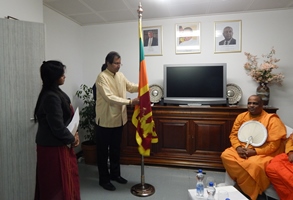
H.E. Ravinatha Aryasinha, Ambassador and Permanent Representative of Sri Lanka, highlighted the key developments following the inauguration-in-office of H.E. the President, and reflected on the importance of reconciliation and integration as the way forward for Sri Lanka. He further stated that a number of important steps were taken by the Government both domestically and internationally to promote reconciliation and economic development of the country. Speaking on the importance of continued contribution by expatriate Sri Lankans to this process, Ambassador Aryasinha stressed the need to work together as one community for a better future for Sri Lanka.
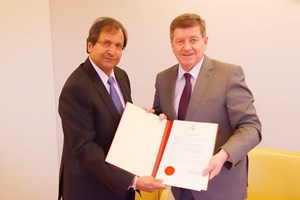 GENEVA (ILO News) – On 12 January 2016, the Government of the Democratic Socialist Republic of Sri Lanka deposited with the International Labour Office the instrument of ratification of the Maritime Labour Convention, 2006 (MLC, 2006). Sri Lanka is the 81st ILO member State and the 16th Asian State to have ratified the Convention.
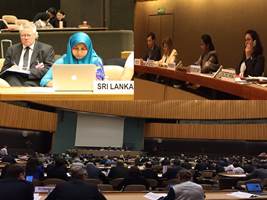
Sri Lanka said that it supports the establishment of a Group of Governmental Experts (GGE) on Lethal Autonomous Weapons Systems (LAWS) in 2017, within the framework of the Convention on Certain Conventional Weapons (CCW) and to elevate the dialogue on LAWS to a State –driven formal process.
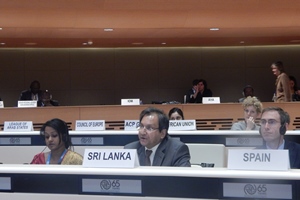
The Director General of International Organization for Migration (IOM) Ambassador William Lacy Swing commended Sri Lanka’s dynamic leadership in Migration in connection with the important role played by Sri Lanka as the current chair of the Colombo Process. In particular Ambassador Swing highlighted the development of the five thematic areas ; Skills and Qualification Recognition, Ethical Recruitment, Pre-departure Orientation, Remittances and Labour Market Trends, under Sri Lanka’s chair of the Colombo Process.
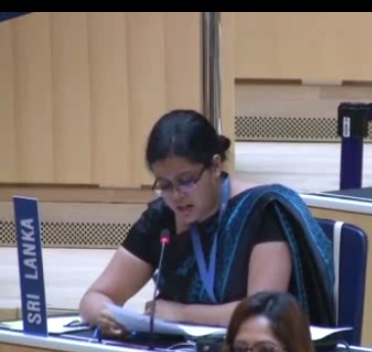
A CDIP Project titled “Intellectual Property, Tourism and Culture” was launched in Sri Lanka through a WIPO Mission undertaken from 2-6 May 2016. This Mission brought together the main stakeholders in the fields of IP, tourism and culture, and a National Steering Committee has been established for the project implementation at national level. In the framework of this Project, the Sri Lanka Tourism Development Authority (SLTDA) has been appointed as the coordinating agency for the project implementation in Sri Lanka.

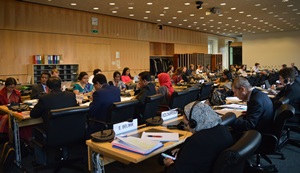
Consideration of the Fifth Periodic Report of Sri Lanka under the Committee Against Torture (CAT) took place at the 59th Session of the Committee Against Torture, held at the Palais Wilson in Geneva, on 15-16 November 2016. Hon. Jayantha Jayasuriya, PC, Attorney General of Sri Lanka and Leader of the Sri Lanka delegation introduced the report.
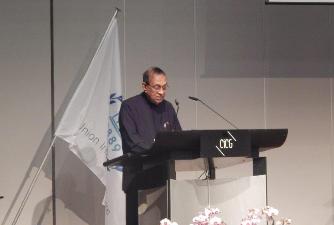
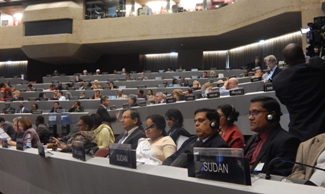
Leading a high-level Sri Lankan Parliamentary delegation to the 135th Assembly of the Inter-Parliamentary Union (IPU) being held from 23-27 October 2016 in Geneva, Hon. Karu Jayasuriya, Speaker of the Parliament of Sri Lanka addressed the General Debate this morning (25 October 2016). The theme of this year’s debate was ‘Human Rights abuses as precursors of conflict: Parliaments as early responders.’
Sri Lanka delegation included Hon. Nimal Siripala De Silva, M.P., Minister of Transport and Civil Aviation, Hon. Vijitha Herath, M.P., Hon. (Mrs.) Rohini Kumari Wijeratne, M.P., Hon. Velu Kumar, M.P. and Mr. Dhammika Dasanayake, Secretary-General of Parliament.