
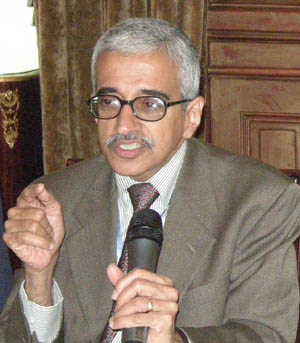
Ambassador Gopinathan Achamkulangare of India, responding yesterday to the remarks on Sri Lanka included in the statement of the High Commissioner for Human Rights Ms. Navi Pillay said, "...it will be prudent to adhere to the outcome of the special session and be sensitive to the concerns expressed already, rather than take a position on contested proposals or controversial issues and ideas, which did not find eventual acceptance in the outcome of the special session."
Sri Lanka's Ambassador Dayan Jayatilleka tells UK, France, to submit their own past military conduct to international inquiry
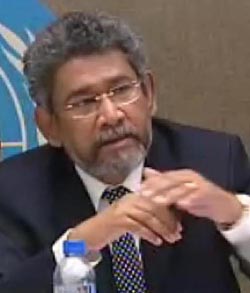
Ambassador Dayan Jayatilleka responding to statements by the EU, UK and France supporting High Commissioner Navi Pillay’s call for an international inquiry into alleged violations of international humanitarian and human rights law in Sri Lanka, made the following remarks at the UN Human Rights Council in Geneva during the General Debate today:
“Mr. President,
Sri Lanka noted with some degree of amusement that the EU, the United Kingdom, Ireland and France were all cheering on the notion of an International Inquiry into allegations of human rights violations conducted “by all sides”, as they put it, to the Sri Lankan conflict.
Sri Lanka's Ambassador Dayan Jayatilleka tells UK, France, to submit their own past military conduct to international inquiry
Ambassador Dayan Jayatilleka responding to statements by the EU, UK and France supporting High Commissioner Navi Pillay’s call for an international inquiry into alleged violations of international humanitarian and human rights law in Sri Lanka, made the following remarks at the UN Human Rights Council in Geneva during the General Debate today:
“Mr. President,
Sri Lanka noted with some degree of amusement that the EU, the United Kingdom, Ireland and France were all cheering on the notion of an International Inquiry into allegations of human rights violations conducted “by all sides”, as they put it, to the Sri Lankan conflict.
Ambassador Dayan Jayatilleka responds to UN Human Rights High Commissioner Navi Pillay’s call for International Inquiry:

Thank you Mr. President, Madam High Commissioner,
Madam High Commissioner welcomed last week’s Human Rights Council Special Session – may I echo that with a slight modification – Sri Lanka welcomes the outcome of last week’s Human Rights Council Special Session. We hope it was as good for the co-sponsors of the Special Session as it was for us in Sri Lanka, though I am not sure I’d recommend that we should all do it again sometime soon.
Sri Lanka’s Ambassador Dayan Jayatilleka speaks at the recently concluded 11th special session of the UN Human Rights Council
The Resolution submitted by Sri Lanka and co-sponsors was adopted with a convincing majority of 29 for and 12 against with 6 abstaining.

The Permanent Mission of Sri Lanka to the United Nations Office in Geneva, in collaboration with the Geneva Press Club - Club suisse de la presse –, organised a press conference on the topic ‘Current Situation in Sri Lanka’, today (24 April 2009) at ‘la pastorale,’ Geneva.