
Intervention on the revised draft
Mr. Chair
Thank you very much for sharing this new draft.
Even though many delegations in this room argued for strengthening of the text in order to ensure that centrality of human control is retained in AWS in order to ensure compliance with international law and IHL in particular, we are quite concerned that the text in several ways is now even further weakened to the extent that we run the risk of even previously agreed understandings are backtracked. Our concerns are mainly with paragraph 20 such as deletion of the word ‘anticipation. Which we believe is already an IHL requirement as well as concerns regarding para 21 in this regard.
Adoption of a substantive repot is important for our delegation as much as it is the same for other delegations but we believe that it should be progressive and forward looking in nature.

Thank you Mr. Chair,
Our comments at this point are with regard to paragraph 25 on legal review. It is the understanding of our delegation that legal reviews with regard to autonomous weapon systems should be inline with the already existing obligations under Art. 36 of the Additional Protocol I and that we should not in anyway agree to obligations on legal review for autonomous weapon systems that are weaker than the already existing obligations under Art,36. It is also recalled that most provisions of the Additional Protocols have gained the status of customary international law. We also note that the obligation under Art 36 of the Additional Protocol I finds its basis in article 35 of the Protocol which provides that the right of states to choose means and methods of warfare is not unlimited.
Art. 36 requires to determine whether the employment of weapons, means and methods of warfare would, ‘in some or all circumstances’ be prohibited by international law. In this sense we believe that the legal review process should consider whether the use of an AWS is in compliance with international law “ in some or all circumstance” and we therefore suggest to make this change in the text. We also support the suggestion by the Swiss delegation as well the delegation of Ireland now to delete the words “ seek to” in this section.

With regard to paragraph 21 on limitations we would like to state at the outset that in our view the purpose of the imposition of these limitations is to ensure ‘ meaningful human control’ in weapon systems on the premise that autonomy in weapon system cannot be unlimited. We do not agree with the argument that the limitations imposed during the stages of development, deployment and use go beyond the existing IHL requirements. To the contrary these limitations are essential to ensure meaningful human control is retained in weapon systems which would be the only way to ensure in turn that these weapon systems in compliance with IHL.
The chapeau of paragraph 21 should refer to international law and to IHL in particular since complexity of these weapon systems pose a challenge not only to IHL but to the broader regime of international law. We also request to remove the qualifier ‘where appropriate’ in this section as these limitations should be upheld at all times. We stress once again the importance of these limitations as well as the prohibitions with regard to autonomous weapon systems codified in the form of a binding legal instrument to ensure their compliance rather than “possible voluntary measures” left for the discretionary implementation of national mechanisms.

As this is the first time my delegation takes the floor, we wish to congratulate you and assures you of our full support as we approach the final stage of this year’s GGE which we believe marks a significant turning point on the future direction on the issue of regulation of the use of autonomy in weapon systems.
In this light we commend the significant efforts you and your team have put on in presenting the draft report of the 2023 session which we consider as a good basis to commence our work for this session.

Mr. Chair,
Our delegation commends your leadership in steering our work in the Group of Governmental Experts and assure you of our continued support as we endeavor to advance our work in the GGE.
As a country that has consistently advocated for the importance of centrality of human control in weapons system and the legal, ethical, military as well as security concerns related to autonomous weapon systems we are encouraged by the recent developments and the growing momentum on the call for regulation in autonomous weapon systems. We consider the joint statement delivered at the UNGA last year supported by 70 states on this subject as well as the Communiqué issued at the Latin American and the Caribbean Conference of Social and Humanitarian Impact of Autonomous Weapons more recently calling for “the urgent negotiation of an international legally binding instrument on autonomy in weapons systems” as important steps forward in this regard. We emphasize on the importance of building on these progressive developments to ensure meaningful human control in weapon systems through the development of an international legally binding instrument.
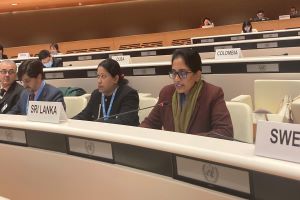
Madam President,
Distinguished delegates,
It is an honour to address this august assembly and to share my country’s perspectives on the work of the Conference on Disarmament, at a time the world is facing myriad of security threats which are at the core of issues discussed at the CD for decades, primarily the threat of nuclear escalation. Other current global security challenges such as transnational organized crime, terrorism, advanced weapon delivery systems add to the dangers associated with the existence of WMD. The situation has heightened the need for progress in global disarmament and the non-proliferation regime which remains the primary purpose of this Conference.
Madam President,
The times are difficult, and our responses require swift action with a sense of collective responsibility, conviction and firm determination. We are deeply concerned about our collective failure to reach a consensus outcome at the 10th Nuclear Non-Proliferation Treaty (NPT) Review Conference, a missed opportunity indeed given our increased vulnerabilities and growing nuclear threats. The implementation of disarmament commitments and obligations have stalled to a great extent, while the expansion and modernization of nuclear arsenals, and the introduction of advanced nuclear weapons continue to take place. We emphasize the equal importance of the three pillars of the NPT; nonproliferation, disarmament, and peaceful uses of nuclear energy and urge for meaningful dialogue to find possible convergence building on our work during the last review conference. Sri Lanka remains committed to the goal of a world free of nuclear weapons, the only guarantee against their proliferation.
- Sri Lanka Statement at the Thematic Session on Negative Security Assurance Conference on Disarmament , 09 February 2023
- Sri Lanka Statement at the Plenary of the Conference on Disarmament , 23 January 2023
- Tenth Meeting of States Parties to the Convention on Cluster Munitions (10MSP) 30 August to 2 September 2022